
Dr. Esther Nyaradzo Masvaya
Academic Executive Director
Overview
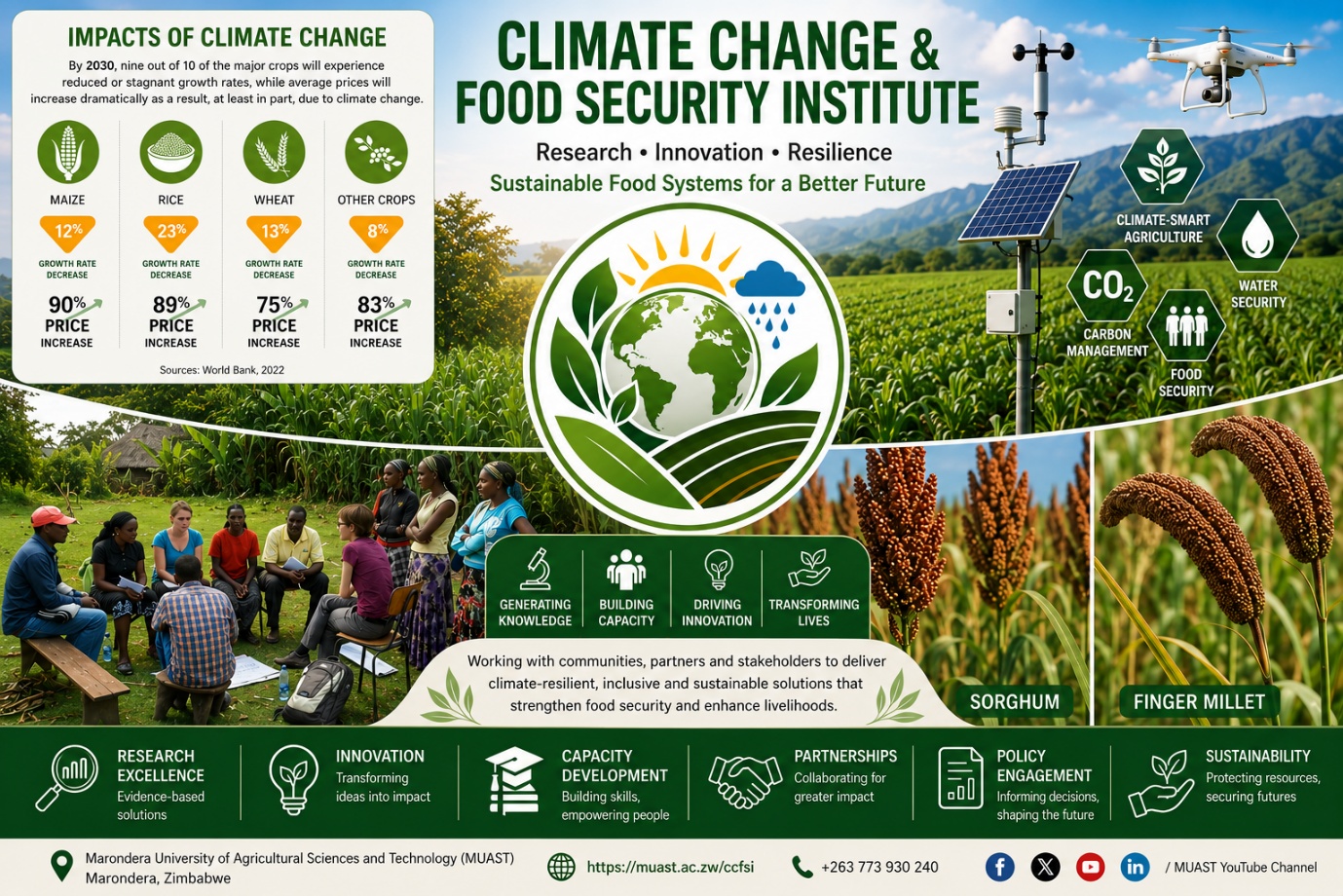
The Climate Change and Food Security Institute (CCFSI) is a multidisciplinary research institute of Marondera University of Agricultural Sciences and Technology (MUAST) dedicated to advancing climate-resilient, technology-driven, and sustainable agrifood systems.
The Institute serves as a centre of excellence for research, innovation, capacity development, policy engagement, and community outreach that address the interconnected challenges of climate change, food security, environmental sustainability, and rural livelihoods. Through strategic partnerships with government, industry, development partners, communities, and academia, CCFSI generates evidence-based solutions that contribute to Zimbabwe's Vision 2030, the National Development Strategy 2 (NDS2), the Sustainable Development Goals (SDGs), and the African Union Agenda 2063.
CCFSI's work spans climate-smart agriculture, sustainable natural resource management, carbon farming, soil health, indigenous food systems, agricultural innovation, food systems transformation, climate finance, and resilience building. The Institute also coordinates multidisciplinary research projects, postgraduate training, technology transfer, and resource mobilisation in support of MUAST's Education 5.0 philosophy.
Our Vision
To be a leading institute in the development of climate resilient, transformative and sustainable, participatory research-based solutions that enhance nutrition, health, livelihoods, and the environment through improved food systems.
Mission
To generate knowledge, develop innovations, build capacity, and foster partnerships that deliver sustainable, climate-resilient and food-secure agricultural systems for national, regional and global development.
Function
Contribute to the overall richness and variety of the mission of MUAST by:
- Conducting cutting-edge, forward-looking research.
- Providing service to individuals and the community through technical backstopping and participatory research.
- Participate in the education of graduate students, fellows, and others.
- Fostering educational opportunities for students.
- Resource mobilisation.
Values
- Excellence – Pursuing the highest standards in research, innovation, and service.
- Integrity – Upholding honesty, accountability, and ethical conduct.
- Innovation – Developing transformative solutions to emerging challenges.
- Collaboration – Building strong partnerships across disciplines and sectors.
- Sustainability – Promoting responsible stewardship of natural resources for future generations.
- Impact – Delivering research that informs policy, transforms communities, and advances sustainable development.



 WhatsApp Channel